Davido may have given Nigeria its first celebrity-assisted IPO roadshow without meaning to.
In June, a document linked to Dangote Refinery's private placement appeared on his X account and then disappeared. The internet, being the internet, had already taken screenshots. Apparently, even one of Africa's largest industrial financings can now arrive with the choreography of a surprise album drop: teaser, frenzy, delete.
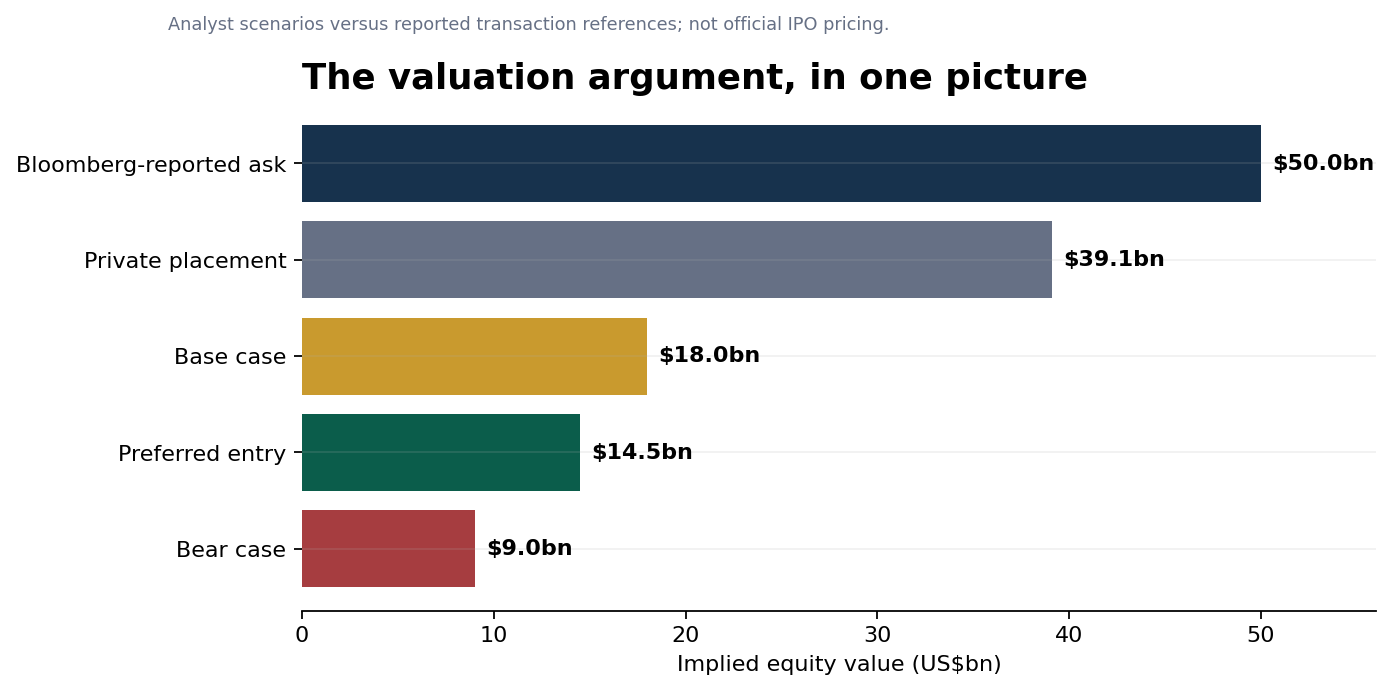
The episode was funny until it was not. The paper reportedly showed three billion shares at US$0.35 each, implying roughly US$39.1 billion for the equity. Bloomberg had earlier reported that Dangote was seeking an IPO valuation near US$50 billion. Then Nigeria's Securities and Exchange Commission ordered a stop to promotion of the supposed public offer, stating on 23 June that no IPO application had yet been filed or approved. Late-July reports subsequently said an application had been submitted. The regulatory sequence matters. Private placement, IPO pre-marketing, filing and approval are four different rooms, even if social media prefers one noisy corridor.
Jay-Z's old line is useful here: “Men lie, women lie, numbers don't.” Quite so, except numbers can arrive unaudited, unreconciled and wearing expensive perfume. The task is not to decide whether the Dangote Refinery is important. It plainly is. The task is to decide what a minority share is worth after debt, maintenance, working capital, governance, expansion risk and the occasional mechanical ambush have collected their share.
There is an old story about blind men meeting an elephant. One finds the flank and declares the animal a wall. Another holds the trunk and calls it a snake. A third embraces a leg and is certain he has discovered a tree. The man at the tusk reports a spear; the one at the ear, a fan. Each man is observant. Each man is also magnificently wrong in proportion to his confidence.
Dangote Refinery is that elephant, except this one cost roughly US$20 billion, consumes crude by the tanker and may soon ask the Nigerian public to buy a small piece of its hide. The engineer touches 650,000 barrels a day and says scale. The patriot feels import substitution and says sovereignty. The trader catches the scent of Atlantic cargoes and says optionality. The lender grips the debt documents and says security. The operator hears a compressor change its note at 2:13 a.m. and says something unprintable. The minority investor reaches for the prospectus and, at the time of writing, catches mostly air.
All of them have found a real part of the animal. None has yet described the whole beast. This article is an attempt to walk around it without being stepped on.
The answer before the sermon
My preliminary value range is US$0.11–US$0.16 per existing share, with US$0.13, about ₦178 using ₦1,370/US$, as the preferred maximum entry before a clean prospectus changes the evidence. On an estimated 111.67 billion pre-IPO shares, US$0.13 implies an equity value of about US$14.5 billion. Add assumed opening net debt of US$3 billion and the enterprise value is roughly US$17.5 billion, or about 6.5 times reconstructed 2027 EBITDA of US$2.7 billion.
At the reported private-placement reference of US$0.35, the equity is worth about US$39.1 billion. At a reported US$50 billion IPO ambition, investors would be paying today for high utilisation, robust refining margins, successful expansion to 1.4 million barrels per day, clean debt separation, favourable tax treatment and respectable minority governance. That is a large wedding list for a courtship in which we have not yet seen the audited accounts.
| The numbers that matter | Preliminary view | What it means |
|---|---|---|
| Preferred entry | US$0.13/share | Approx. ₦178/share at ₦1,370/US$ |
| Underwriting range | US$0.11–US$0.16 | Requires clean prospectus disclosures |
| Equity value at US$0.13 | US$14.5bn | Based on estimated 111.67bn existing shares |
| Enterprise value | US$17.5bn | Assumes US$3.0bn opening net debt |
| Modelled 2027 EBITDA | US$2.7bn | Reconstructed, not company guidance |
| Entry multiple | 6.5× EV/EBITDA | Discounted for present uncertainty |
| Private-placement reference | US$39.1bn | About US$0.35/share; not official IPO pricing |
| Reported IPO ambition | About US$50bn | A marketing aspiration, not intrinsic value |
This is not a claim that the steel, tanks, jetties and process units are worth only US$14.5 billion. It is a statement about what public investors should pay for the cash flows left after everybody else has been served.
The good: Nigeria finally built the thing
It is easy to become so clever about valuation that one misses the industrial achievement. Nigeria spent decades exporting crude and importing the products made from it, the national equivalent of selling cocoa beans and buying back chocolate at Heathrow prices. State refineries with combined nameplate capacity around 445,000 barrels per day became recurring characters in the national theatre: rehabilitated, recommissioned, celebrated, then strangely quiet.
Dangote built a functioning refinery.
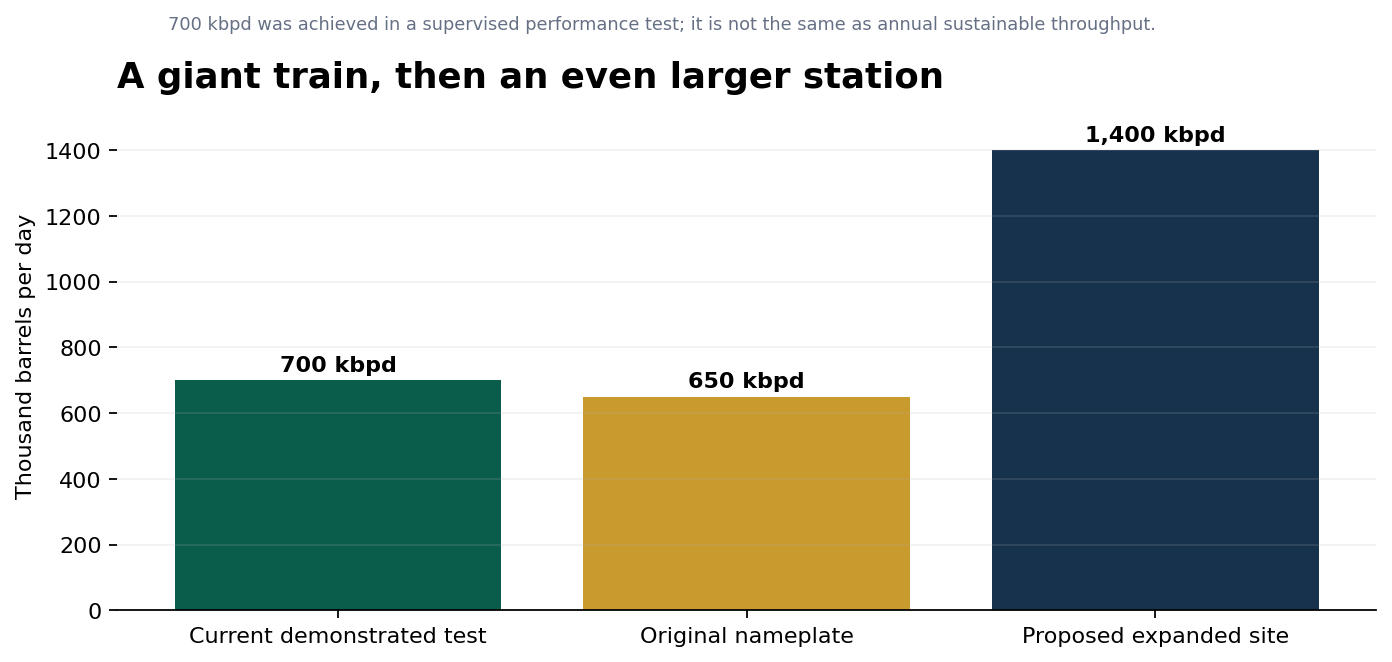
The Lekki complex cost more than US$19–US$20 billion, began commercial operations in 2024 and was designed at 650,000 barrels per day. A licensor-supervised test reportedly took crude throughput above 700,000 barrels per day in 2026. The site integrates refining, petrochemicals, storage and marine export infrastructure. Industry estimates place its Nelson Complexity Index near 10.5, suggesting a sophisticated conversion refinery rather than a glorified crude kettle.
How big is big? Jamnagar in Gujarat remains the leviathan, a two-refinery Reliance complex of roughly 1.24 million barrels per day. Venezuela's Paraguaná complex is commonly listed near 955,000 bpd, although nameplate capacity and reliable output have not always attended the same meetings. South Korea's Ulsan, Yeosu and Onsan sites illustrate what mature export refining looks like: enormous coastal plants embedded in deep industrial ecosystems, with decades of operating history and customers who do not need directions to the jetty. ADNOC's Ruwais complex sits above 800,000 bpd. The great US Gulf Coast refineries live inside the world's most developed refining, pipeline, storage and trading network.
Against that company, Dangote is no provincial curiosity. At the 700,000 bpd supervised test rate, it climbs above Onsan and Port Arthur, landing around seventh on the capacities used here. At the proposed 1.4 million bpd, it would overtake Jamnagar and become the largest refining site in the comparison. That is not an extension in the way a landlord adds a boys' quarters. It is another Dangote-sized refinery beside the first one, with another refinery's appetite for steel, crude, working capital, maintenance and sleep.
But one must compare like with like. Jamnagar, Paraguaná and Ruwais are complexes assembled from multiple trains or refinery units; Dangote's distinction is the scale concentrated in one crude train. A performance test is also a sprint in polished shoes, not a rainy-season marriage. It proves the plant can touch the number under defined conditions. It does not prove it can live there through feed changes, catalyst ageing, harmattan dust, power disturbances, turnaround cycles and the small mutinies of rotating equipment.
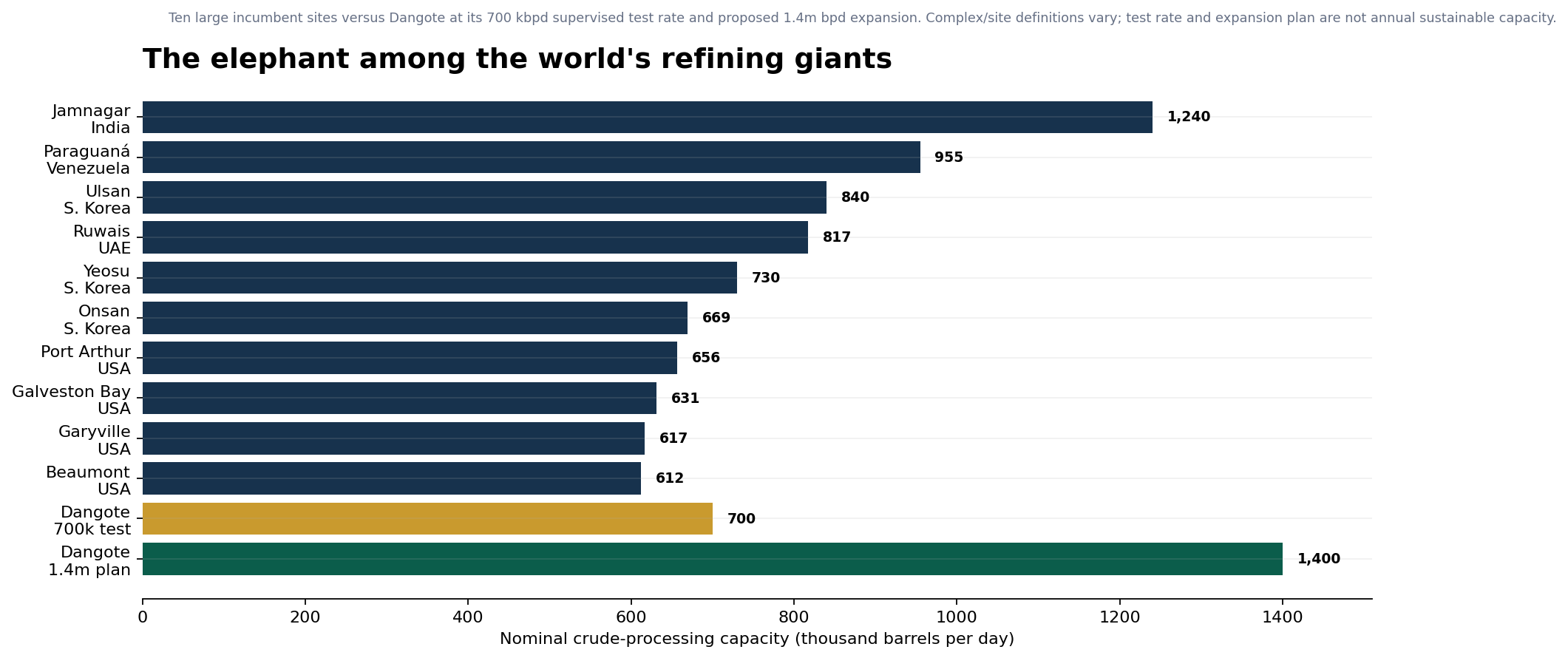
The chart contains two Dangotes. The gold bar is the 700,000 bpd refinery demonstrated during a supervised test. The green bar is the proposed 1.4 million bpd destination. One is a peak operating result that still needs a long reliability record; the other is steel not yet fully built and cash flow not yet earned. Investors will eventually need a third measure for each: the refinery that turns up, day after day, in audited annual throughput. Those bars do not yet exist.
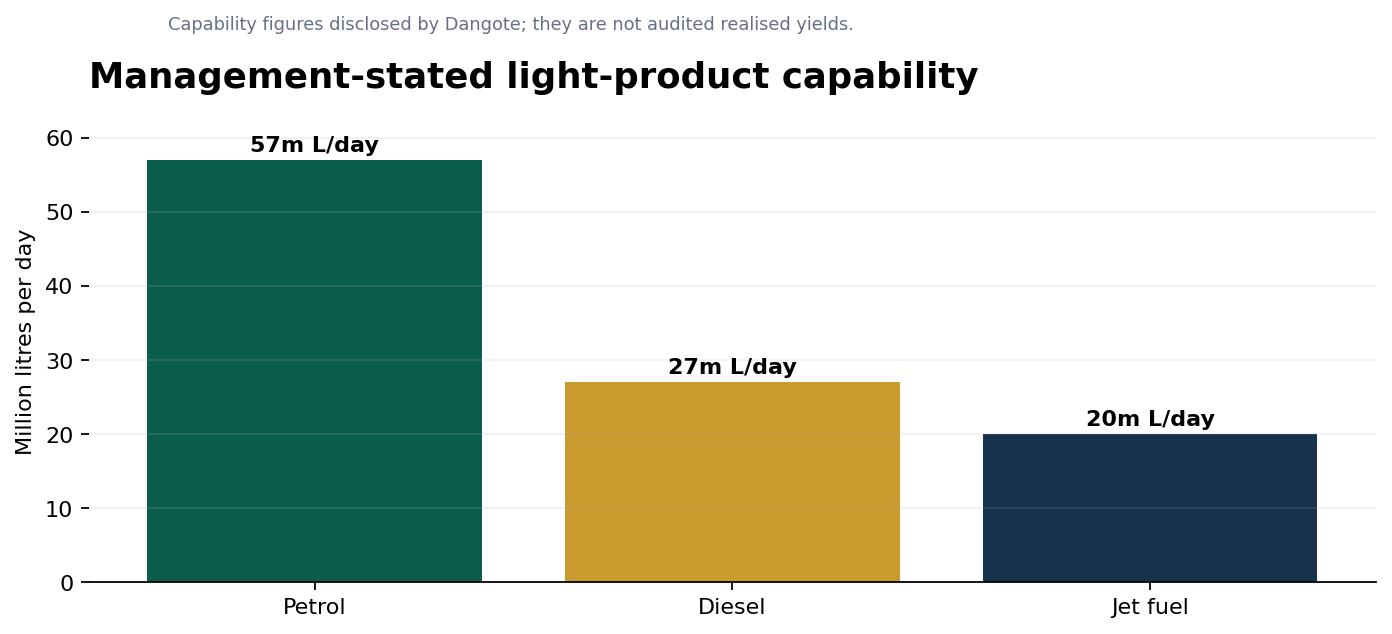
Management states daily light-product capability of roughly 57 million litres of petrol, 27 million litres of diesel and 20 million litres of jet fuel.
The home-market advantage is real. The US Energy Information Administration estimated that Nigeria imported an average of roughly 376,000 barrels per day of petroleum products in 2020–2024. A large coastal refinery can replace freight-heavy imports, turn inventory faster, supply cleaner fuels and sell surplus cargoes into West Africa and the Atlantic Basin. Reuters, citing Kpler, reported Nigerian product exports of about 353,000 bpd in April 2026, before they slipped to around 285,000 bpd in May.
It is not merely a Nigerian import-substitution machine. Its jet fuel has reached Britain; its diesel and petrol can reach African and international customers; its scale gives it bargaining power with crude suppliers, traders, shippers and equipment vendors. The asset may become to African refining what Dangote Cement became to African building materials: a regional system, not merely a factory.
The Bible says, “By their fruits ye shall know them.” The refinery has produced fuel, displaced imports and exported cargoes. Those are fruits. They deserve more respect than PowerPoint capacity.
There is also a national comedy hidden here. For years Nigeria owned refineries the way a neighbour owns an old Mercedes under a tarpaulin: with pride, memory and recurring invoices, but very little movement. Every December he points at it and tells the street what the engine once sounded like. Committees inspected our own. Budgets washed them. Somebody always knew a mechanic. But “I get am before no be property.” Former possession is not present performance, whether the subject is a W123 in the compound or 445,000 barrels a day printed in a government brochure. Dangote, whatever one thinks of the financing, removed the tarpaulin and built an engine that actually turned. That deserves its flowers. It does not deserve a blank cheque.
The elephant: one enormous train
Now we reach my long-standing discomfort. Dangote is the world's largest single-train refinery. That phrase is usually offered as a trophy. It should also be read as an insurance disclosure.
I have spent long enough around oilfields, operating envelopes and commercial promises to know that plants break. They also foul, vibrate, leak, trip, corrode, coke up and develop sudden religious objections to running on the exact morning a cargo is due. Maintenance rarely consults the investor-relations calendar. Your insurer cares. Your OEM warranty cares. Your safety case cares. And the pesky integrity team arrives with terms such as FFS, meaning fitness for service, not the other FFS, although the emotional effect can be identical.
A multi-train plant can sometimes lose one unit and keep part of its earning engine alive. A giant single-train site concentrates throughput behind fewer critical paths. Dangote has redundancy in utilities and supporting equipment, but a prolonged problem in the crude distillation unit, residue fluid catalytic cracker, hydrogen system, power generation, marine facilities or wastewater treatment can remove a large share of profitable output.
The distinction is not academic. If one burner goes out in a Lagos suya stand, the proprietor shifts the meat, abuses the charcoal and continues trading. If the only grill goes cold, the onions remain decorative and the evening's EBITDA becomes smoke without the useful part. A refinery is infinitely more engineered, but the commercial principle is recognisable: redundancy buys time, and time is what contracts, customers and cash flow consume.
This is not theoretical. The petrol-making RFCC, about 204,000 bpd, has suffered repeated interruptions. It was shut in 2025 after catalyst leaks and other problems, went through turnaround work, ran at reduced rates in April 2026 because of temperature-control trouble, and was derated by 34% from 21 May 2026 amid feed-composition and valve problems. Reports have sometimes used “shutdown” loosely; investors should distinguish a full-refinery stoppage from an RFCC outage or derating. The commercial point survives the vocabulary: a refinery may still be “running” while losing the high-value conversion that makes petrol and supports the best margins.
This is where the chicken has come home to roost, inspected the vibration data and asked why the spare train was deleted at concept select.
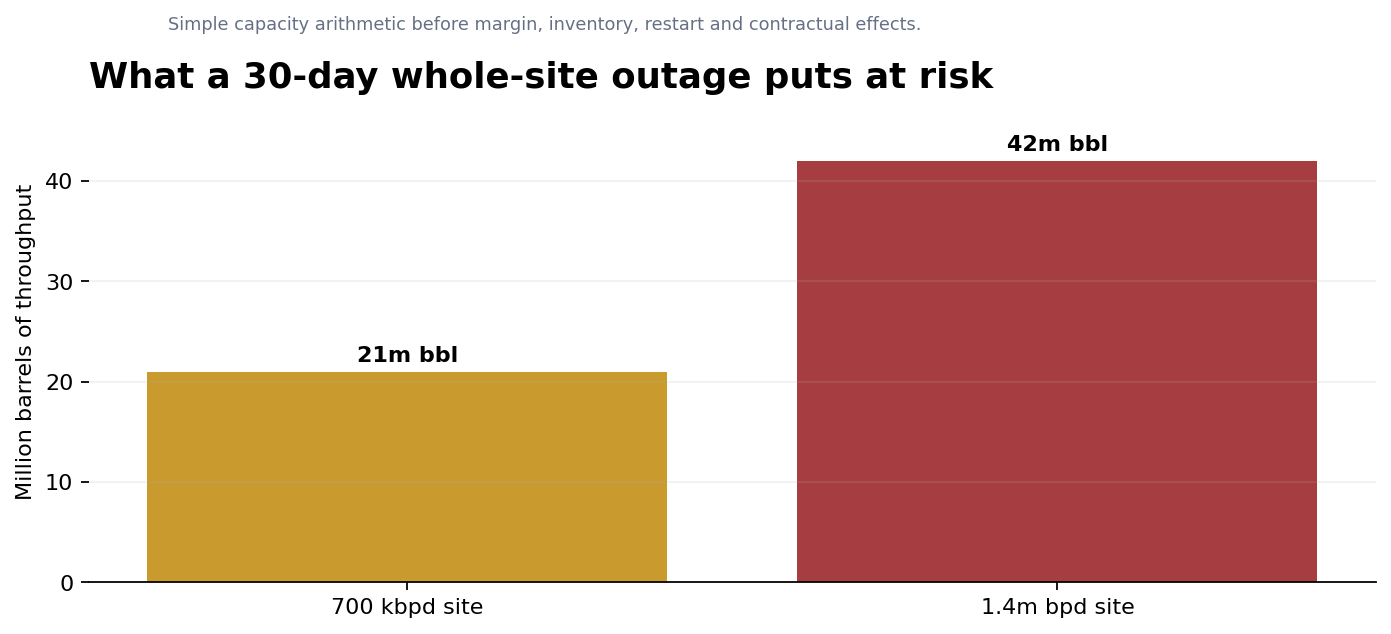
At 700,000 bpd, a 30-day whole-site outage puts about 21 million barrels of throughput at risk. At 1.4 million bpd, it becomes 42 million barrels. Lost EBITDA is not simply barrels multiplied by headline refining margin. There are inventory effects, restart losses, contractual penalties, emergency imports, catalyst costs and the possibility of selling a poorer product slate. But the direction is not ambiguous.
Coleridge's mariner had “water, water, every where” and none to drink. Nigeria can have crude in the ground, tanks by the sea and motorists at the gate, yet still discover that one unavailable conversion unit stands between abundance and petrol.
For the IPO, I would require an independent engineer's report showing monthly 2024–2026 availability for each major unit, causes and duration of trips, mean time between failures, critical spares, inspection findings, turnaround plan, insurer exclusions, open warranty claims and the capital required to reach mature reliability. A 700,000-barrel performance test is impressive. It is not the same thing as 365 days of sellable yield.
The refinery makes revenue. Does it make distributable cash?
Refineries produce gigantic revenue numbers because crude passes through the income statement. Revenue is therefore an unreliable applause meter. At 225 million barrels a year, a US$10 move in crude can shift reported revenue by more than US$2 billion without creating a similar increase in profit.
Throughput × realised refining margin, less operating cost, maintenance, working capital, interest, tax and growth capital.
Crack spreads: where the barrel earns its keep
A crack spread is the pricing difference between a barrel of crude oil and the refined petroleum products, such as petrol and diesel, derived from it. The widely followed 3-2-1 crack spread imagines that three barrels of crude become two barrels of petrol and one barrel of diesel. Take the market value of those products, subtract the cost of the three barrels of crude, divide by three, and you have a rough margin per barrel. It is the refinery business reduced to the arithmetic one might do on the back of a loading programme while pretending not to watch the cargo demurrage clock.
Useful, yes. Profit, not quite. The crack spread does not pay wages, replace catalyst, run hydrogen plants, finance inventory, repair an RFCC or persuade a compressor to abandon its latest creative phase. It also assumes a simple product yield. Dangote is a complex refinery with petrol, diesel, jet fuel, naphtha, polypropylene and other streams, while crude quality, freight, discounts, domestic pricing and export mix all alter the realised gross refining margin. A benchmark is a ruler, not the furniture.
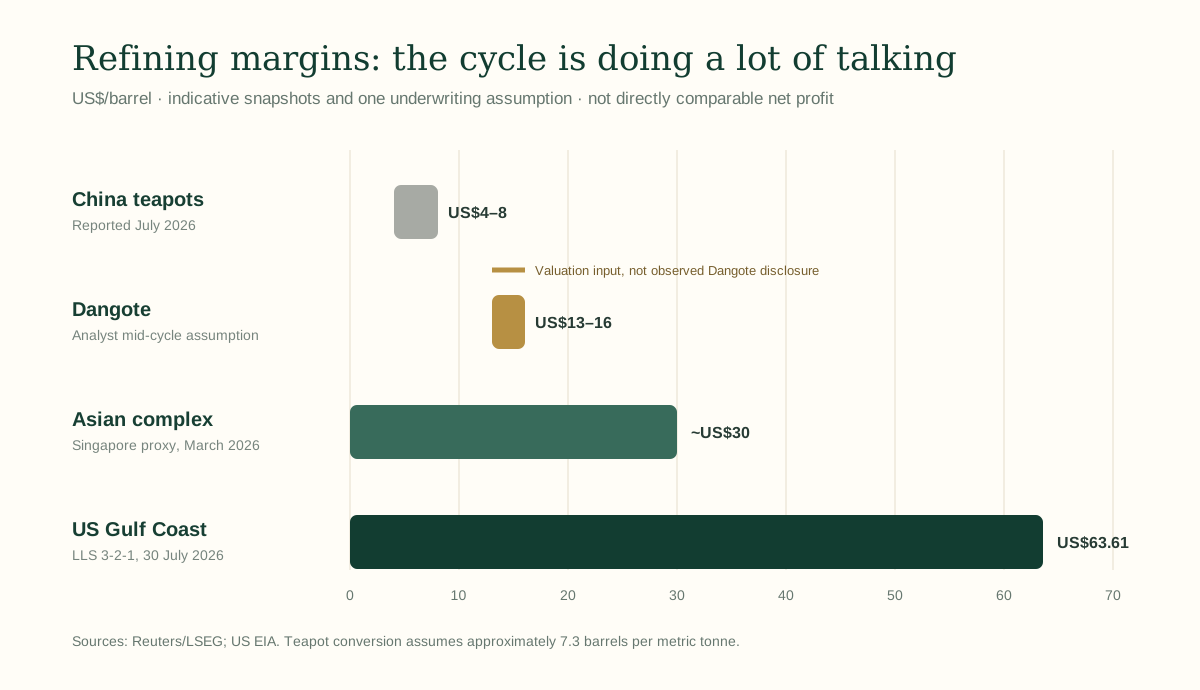
The chart is deliberately awkward because the market is awkward. China's independent “teapot” refineries, nimble buyers of discounted crude but constrained by quotas and policy, were reported around 200–400 yuan per tonne in July, roughly US$4–US$8 per barrel after conversion. Singapore's complex margin, the usual Asian proxy, touched almost US$30 per barrel during the March disruption. The US Gulf Coast LLS 3-2-1 stood at US$63.61 on 30 July. Those are not normal numbers arriving in sensible shoes; they are conflict, disrupted trade and product scarcity shouting through the price screen.
Dangote's model therefore stays at US$13–US$16 per barrel through the cycle. That is less exciting than annualising today's American crack and producing an IPO valuation visible from the moon. It is also more defensible. Dangote may at times outperform because of complexity, freight advantage, discounted crude or a favourable product slate. It may underperform when the RFCC is unavailable, domestic price competition bites, crude differentials move against it or exports clear at weaker netbacks. The prospectus must reconcile benchmark cracks to the refinery's realised GRM, and realised GRM to EBITDA and cash. Without that bridge, a large crack spread is merely a large number walking around unsupervised.
| Operating assumption | Base case | Status |
|---|---|---|
| Effective capacity | 700,000 bpd | Short test, not sustainable annual proof |
| Sustainable utilisation | 88% in 2027 | Analyst assumption |
| Annual crude throughput | 224.8m barrels | Calculated |
| Gross refining margin | US$16/bbl | Upper end of mid-cycle base range |
| Cash refining cost | US$4.70/bbl | Analyst assumption |
| Petrochemical and other revenue | US$1.2bn | Analyst assumption |
| Total revenue | US$22.3bn | Reconstructed; crude-price sensitive |
| EBITDA | US$2.7bn | Reconstructed |
| Maintenance capex | US$0.55bn | Analyst assumption |
| Expansion capex in 2027 | US$4.0bn | Analyst phasing assumption |
| 2027 FCFF | Negative US$1.3bn | Expansion consumes operating cash |
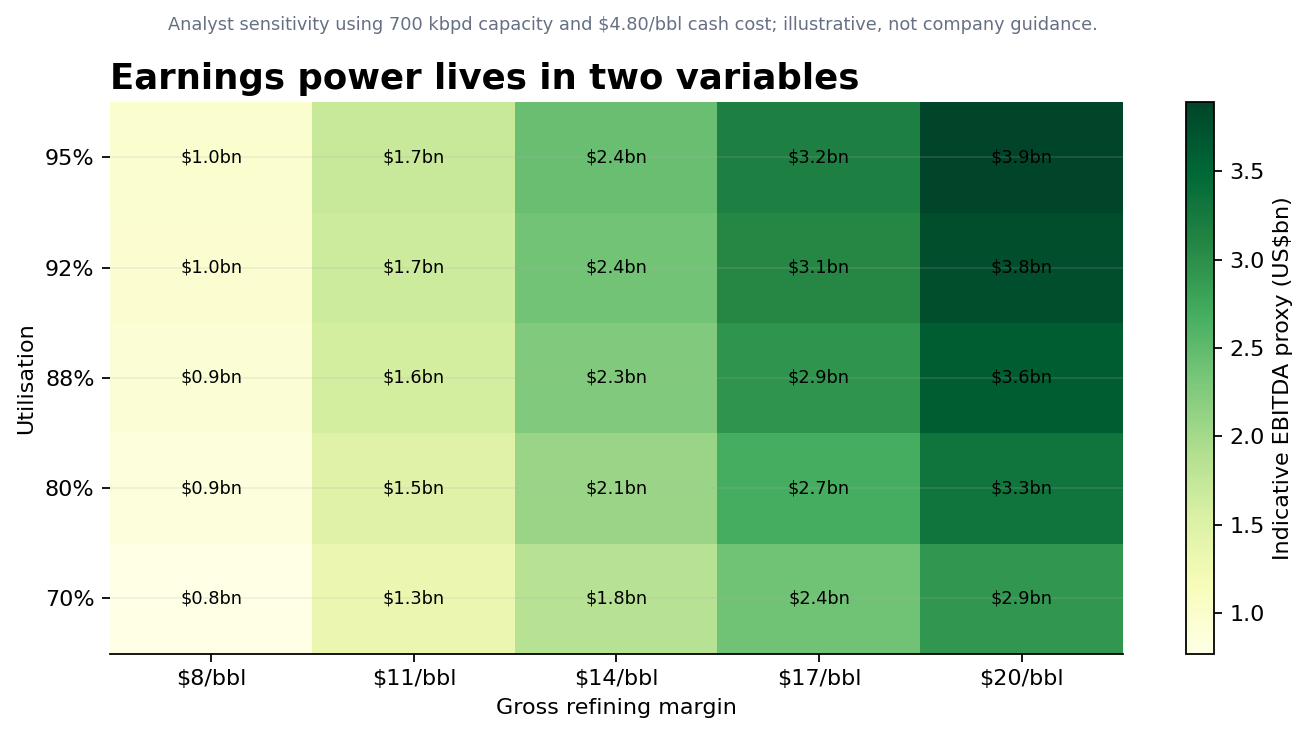
The heat map explains why small disagreements create large valuations. At this scale, one dollar per barrel of recurring margin can add roughly US$225 million of annual gross contribution at 88% utilisation. Five points of utilisation can add perhaps US$145–US$200 million of EBITDA before secondary effects. The sponsor naturally tells the story from nameplate capacity downward. The investor should build it from reliable unit-days upward.
Maintenance capex deserves adult treatment. A refinery is not an app. Steel does not refresh itself in the cloud. Catalysts deactivate, refractory fails, compressors require overhauls, exchangers foul, marine structures corrode and safety systems become obsolete. I assume routine annual maintenance plus a major turnaround roughly every four years, with sustainable utilisation capped around 92% rather than the immaculate 100% that sometimes wanders into promotional arithmetic.
Nameplate capacity is the number on the wedding invitation. Availability is the marriage: long, revealing and occasionally interrupted by people asking who authorised the expenditure. The mature Gulf Coast and South Korean giants have spent decades learning their own noises, corrosion circuits, catalyst habits and spare-parts politics. Dangote may learn quickly, but the market should not pay in advance for lessons not yet completed.
Working capital: the quiet billionaire
At 700,000 bpd and crude around US$75–US$80, thirty days of feedstock represents roughly US$1.6 billion of crude inventory. Add products in tanks and transit, receivables, letters of credit, collateral, demurrage and the timing mismatch between naira sales and dollar crude purchases, and operating working capital can comfortably exceed US$2 billion.
This is why the naira-for-crude arrangement matters beyond politics. A refinery buying crude in dollars and collecting a portion of sales in naira has translation and liquidity risk even if domestic prices notionally follow import parity. Dangote temporarily suspended naira fuel sales in 2025 when naira product sales exceeded naira-denominated crude receipts. The lesson is not that the business lacks a natural dollar hedge. It is that an economic hedge and a cash-flow hedge are cousins, not twins.
The prospectus must disclose crude title-transfer terms, supplier credit, trader prepayments, inventory-repurchase agreements, receivables factoring, letters of credit, margin requirements and customer payment days. If crude sits in the tank but somebody else owns it, the balance sheet may look lighter while the contractual risk has merely changed clothes.
Debt: do not add every headline, but do not ignore any footnote
The historic construction financing is complicated. Public documents identify syndicated bank loans, development-bank and export-credit facilities, Dangote Industries bonds for which the refinery and fertiliser entities were co-obligors, later US$4 billion refinancing facilities and a US$1.65 billion Greenview parent/shareholder loan that Fitch had described as callable on demand at end-2024. Reuters reported a US$2.5 billion private placement in July 2026 intended to strengthen the financing structure and support expansion.
These figures must not simply be added. Some facilities refinance or replace earlier debt. But neither should they be waved away with the phrase “capital restructuring”. Before buying one share, investors need a debt table by legal entity, currency, rate, maturity, security, covenant and guarantor, plus a bridge from gross debt to net debt and a reconciliation of the 2025 and 2026 US$4 billion announcements.
The hidden-debt checklist is equally important: supplier payables, trader prepayments, minimum-volume commitments, take-or-pay gas and power contracts, inventory monetisation, factoring, EPC claims, tax clawbacks, environmental provisions, parent guarantees and cross-defaults. Equity is what remains after claims. If we cannot map the claims, we cannot confidently value the remainder.
My base model assumes US$4 billion of opening gross debt, expansion borrowing that takes gross debt toward US$8 billion, and an average dollar cash interest rate near 9.5%. Those are deliberately visible assumptions, not discovered facts.
The second refinery hidden inside the first
Management proposes to expand the Lekki site to around 1.4 million bpd, with additional petrochemical capacity. That could create the world's largest refining site and turn Dangote into a strategic supplier far beyond Nigeria. It could also consume roughly US$11 billion of additional capital in this model, with cost overruns, delays and another round of commissioning risk.
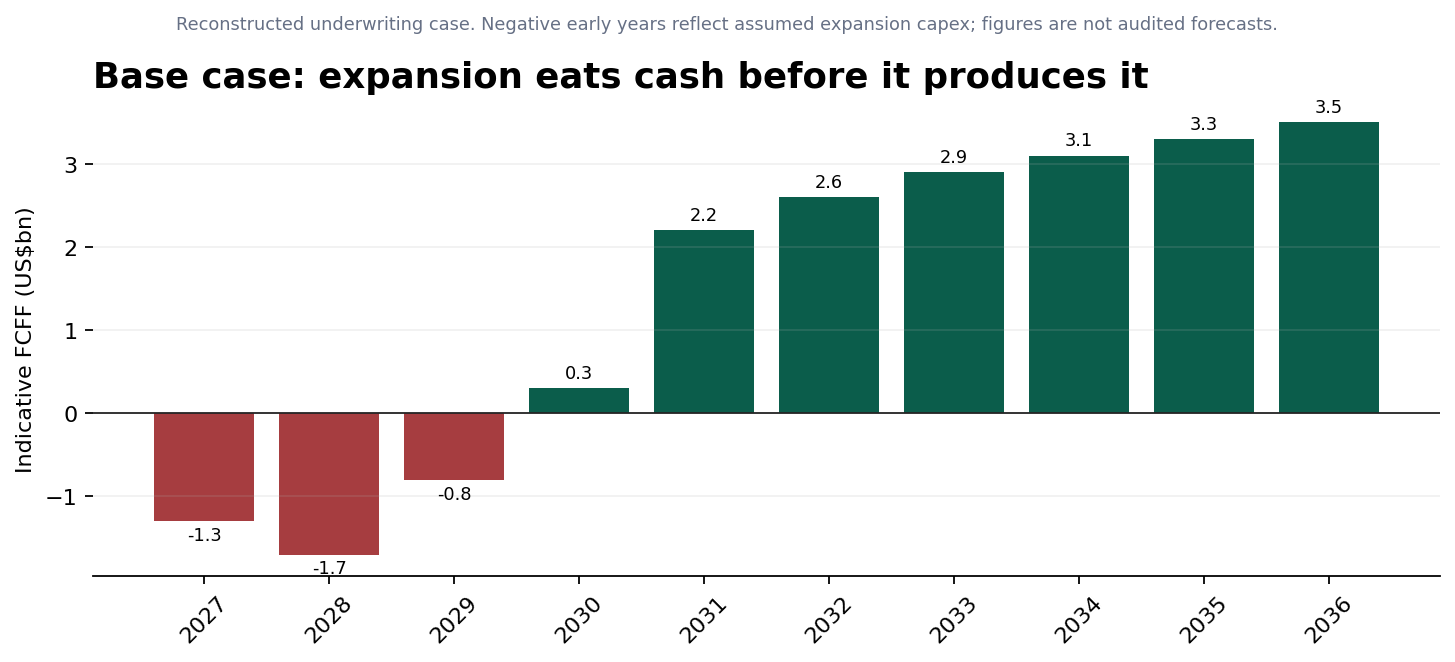
The expansion explains why an IPO can be attractive to the sponsor and dangerous to an undisciplined subscriber. New shareholders provide permanent capital just before the cash-hungry years. In the base case, free cash flow is negative through the heaviest construction period and becomes strongly positive only after successful commissioning. The investor is not merely buying today's refinery. The investor may be financing tomorrow's refinery while carrying yesterday's debt.
The first project took close to a decade and cost far more than early estimates. The second may benefit from site infrastructure, operating knowledge, procurement relationships and a warmer lender reception. It may also face the old gods of megaprojects: scope growth, interface failure, foreign-exchange movement, imported-equipment delay and the confident schedule that looks excellent until reality attends the meeting.
Every megaproject begins with a Gantt chart whose bars stand straight like soldiers on parade. Then geology speaks, a vessel is delayed at sea, a contractor discovers that the drawing marked “final” was merely emotionally final, and somebody creates Revision 19. This is not cynicism. It is how large plants introduce themselves. The appropriate response is contingency, transparent reporting and a valuation that does not require Saint Jude, patron of lost causes, to join the project-controls team.
Charles de Gaulle observed that “Deliberation is the work of many men. Action, of one alone.” Dangote's ability to act is a competitive advantage. Public shareholders, however, require deliberation because they will be asked to fund decisions they do not control.
I would assign little value to the expansion until the prospectus provides the EPC structure, fixed and variable price components, contingency, financing commitments, independent schedule review, second-train configuration, shared-utilities bottlenecks and clear rules preventing cost transfers from related Dangote entities.
The moat is real, but it is not a drawbridge
- Scale and complexity. A 650,000–700,000 bpd high-conversion coastal refinery can spread fixed costs and produce a valuable slate.
- Domestic freight advantage. It sits beside a structurally import-dependent market.
- Marine optionality. Export access creates dollar revenue and outlets for diesel, jet fuel and surplus petrol.
- Integration. Storage, petrochemicals and logistics can lift site economics.
- Sponsor capability. Dangote has unusual access to capital, government, contractors and African distribution.
But access is not immunity. Domestic pricing is politically sensitive. Marketers can import when landed economics work. Nigerian crude supply remains constrained by mature assets, theft, pipeline failures and underinvestment. The refinery has already imported US crude. At 1.4 million bpd, the site would require something close to Nigeria's recent total crude-and-condensate output if it tried to feed itself domestically. International crude procurement and international product competitiveness become central, not peripheral.
Nor is the Atlantic Basin a private compound. US Gulf Coast, European, Middle Eastern and Indian refiners will sell into any attractive margin. Dangote's location is helpful; it does not repeal commodity cycles. When petrol or diesel cracks fall, patriotism will not make a trader pay above landed alternative cost forever.
Governance: what exactly will the public own?
This is the section most likely to be lost amid photographs of towers at sunset.
NNPC's stake fell from a contemplated 20% to 7.2% after it did not complete agreed funding. The sponsor and related entities therefore retain overwhelming control. The group spans cement, fertiliser, logistics, ports and other businesses. That creates efficiencies and many possible tunnels through which value can travel: intercompany loans, guarantees, shared services, construction contracts, land leases, procurement, logistics charges, tax sharing and cash pooling.
The prospectus must show the legal perimeter. Do shareholders own the refinery plant and land? The marine terminals and tankage? The petrochemical units? The trading entity? Expansion assets under construction? Claims against EPC contractors and insurers? Which historic bonds retain refinery guarantees? A share certificate labelled “Dangote Refinery” is not enough.
Minimum protections should include a genuinely independent audit committee, no differential voting shares, arm's-length and publicly disclosed related-party transactions, prohibition of cross-guarantees without minority approval, a fixed-maturity shareholder loan, an internationally recognised auditor, an independent engineer's annual reliability report, a 24-month sponsor lock-up and a free float large enough for price discovery rather than ceremonial compliance.
Jane Austen wrote, “If I loved you less, I might be able to talk about it more.” The market may love the Dangote name too much to ask awkward questions. Minority investors should reverse the arrangement: talk about it more before loving it at US$50 billion.
Bear, base and bull
| Case | What has to happen | Equity value | Approx. value/share |
|---|---|---|---|
| Bear | 70–78% utilisation; US$8–US$11/bbl GRM; repeated RFCC trouble; expansion delay | US$7bn–US$11bn | US$0.06–US$0.10 |
| Base | 86–90% utilisation; US$13–US$16/bbl GRM; operations mature; manageable slippage | US$14bn–US$20bn | US$0.13–US$0.18 |
| Bull | Above 92%; strong margins; clean governance; expansion on budget; rapid deleveraging | US$24bn–US$32bn | US$0.21–US$0.29 |
| Private placement | Market transaction reference, not a valuation conclusion | US$39.1bn | US$0.35 |
| Reported IPO ambition | Requires the bull case plus a scarcity premium | About US$50bn | About US$0.45 |
These values are illustrative and highly sensitive to share dilution. The per-share figures use the reported pre-IPO share count and will change if the private placement, conversion instruments or IPO create additional shares. A primary issuance can increase equity value while still diluting each existing share's claim; the fully diluted denominator matters.
At US$0.13, the base-case model produces only a low-teens five-year return, not instant alchemy. At US$0.35, even good operating performance may leave public investors dependent on multiple expansion rather than cash generation. A wonderful asset bought at an heroic price can spend years teaching humility.
What would make me pay more?
- clean standalone IFRS accounts with an unqualified audit opinion;
- monthly throughput, unit availability, realised yields and GRM-to-cash reconciliation;
- sustainable RFCC and CDU reliability through a full operating cycle;
- complete debt, guarantees and related-party reconciliation;
- a lower fully funded expansion cost with credible contingency;
- clear free-zone tax treatment for domestic and export sales;
- a majority-independent board and enforceable minority protections;
- no on-demand parent loan or cross-guarantees to unrelated group companies;
- primary proceeds directed to debt reduction and high-return expansion, not secondary selling;
- enough free float and disclosure to support genuine institutional price discovery.
Until then, the correct status is watchlist, not worship list.
Final judgement
Dangote Refinery may become one of Africa's defining listed companies. It is already a defining industrial asset. It has altered Nigerian fuel supply, changed regional trade flows and shown that private capital can build what decades of public promises did not. The scale is glorious. The logistics are valuable. The home market is hungry. The export option is real.
The risks are equally physical: a huge single-train concentration, immature reliability history, large working-capital needs, incomplete debt visibility, sponsor control and an expansion that may consume billions before it produces a dividend. These are not reasons to sneer at the refinery. They are reasons to price the shares like an owner rather than applaud them like a guest at commissioning.
My line remains US$0.11–US$0.16, with US$0.13 as the preferred maximum before the prospectus answers the difficult questions. At US$0.35, I would pass unless audited figures materially exceed the base case. Near US$50 billion, the price appears to include not only the elephant in the room but the room, the furniture and the next building.
The refinery is excellent. The IPO may be excellent. They are not automatically the same proposition.